
About the Pierce County Clerk's Office
Ivan Sandoval serves as the elected Clerk of the Superior Court for Pierce County. The Washington State Court Directory lists him at 930 Tacoma Ave S, Room 110, with the main office number at 253-798-7455. County clerks in Washington are elected officials. Their core duty is to maintain official court records and oversee record-keeping for the Superior Court. The Clerk is not a judicial officer and does not give legal advice, but the office is the central stop for anyone who needs a copy of a filed document.
The Clerk's office sits in the County-City Building in downtown Tacoma, the same building that houses Superior Court, District Court, the Prosecuting Attorney, and Tacoma Municipal Court. Room 110 is the public-facing room for records and copies. The office provides services in eight main areas: Request Court Records, E-Filing, Self-Help Resources, Misc Forms, Case Information, Pretrial Services, Rules & Fees, and FAQs. Each category has its own workflow, and staff can direct visitors to the right path at the counter.
Pierce County Clerk of the Superior Court
Clerk: Ivan Sandoval
930 Tacoma Ave S, Room 110
Tacoma, WA 98402-2177
253-798-7455
Fax: 253-798-3428
Office hours: Mon-Fri, 8:30 a.m. to 4:30 p.m.
Phone hours: Mon-Fri, 8:30 a.m. to 3:30 p.m.
Notice: Beginning December 1, 2025, the Clerk's Office no longer takes phone calls after 3:30 p.m. In-person counter service continues until 4:30 p.m.
What the Pierce County Clerk Does
Washington law makes the county clerk the official keeper of Superior Court records. In Pierce County that role goes well beyond filing stamps. The Clerk's office handles every case type that moves through Superior Court: felony criminal cases, civil lawsuits, domestic matters, probate estates, guardianships, and tax warrants. It issues process, collects fees, manages court calendars, runs the e-filing workflow, screens applicants for the Department of Assigned Counsel, and maintains the LINX document system for public access to post-2002 documents.
The Pretrial Services function is worth noting. When a court orders a person to apply for assigned counsel, the application is screened through the Clerk's Office. Staff check whether the applicant meets the indigency standard for the Department of Assigned Counsel, which provides mandated public defense for eligible defendants in criminal, juvenile delinquency, dependency, termination, and involuntary commitment matters. The Clerk also manages protection order filings. Civil protection order initial requests may be submitted through online kiosks in the building or in person at Room 110.
- File and maintain Superior Court case records for all case types.
- Issue summons, writs, and other court process documents.
- Accept and process e-filed documents through LINX.
- Manage certified and non-certified copy requests in person, by mail, and online.
- Screen indigency applications for the Department of Assigned Counsel.
- Maintain self-help resources for pro se litigants in divorce, probate, protection orders, and related matters.
LINX and Pierce County Court Records Access
The primary public tool for searching Pierce County Superior Court records is LINX, the Legal Information Network Exchange. Pierce County built LINX locally and has run it for nearly 20 years. The public can use the LINX search page to look up cases by name or cause number, view attorneys, charges, dockets, proceedings, and judgments, and access documents filed after January 1, 2002. No other county in Washington runs the same system, which means LINX searches are specific to Pierce County.
For Superior Court documents, the LINX search form asks for a cause number, a party name in last name/first name format, a year range, and a case type. The case types are Criminal, Civil, Domestic, Probate/Guardianship, and Tax Warrant/Judgment. Once a case appears in search results, users can click through to view the docket, charges, judgments, and available documents. Purchasing document access is done directly in LINX. For records before 2002, the process differs and is covered in the request section below.
Note: LINX is available only for Pierce County. Statewide searching uses the Washington Courts Find My Court Date portal for district and municipal proceedings.
How to Request a Certified Copy
Certified copies carry the Clerk's official seal and signature, making them acceptable for legal proceedings, loan applications, title actions, and most official purposes. The fee is set by RCW 36.18.016(4). One important limitation: Social Security Administration does not accept electronically certified documents, so anyone requesting certified copies for a Social Security matter must order paper copies in person or by mail, not through LINX.
There are three ways to get a certified copy from Pierce County Superior Court: in person at Room 110, by mail, or online through LINX for post-2002 documents. Each path has the same fee structure but a different payment flow. Mail requests take longer because the requester must send payment before the Clerk can process the order. The step-by-step below covers the most common path for general users.
- Locate the cause number. Use the LINX search page to find the case by name or cause number. Write down the cause number and the exact names of the documents you need.
- Choose your request method. For post-2002 documents, log into LINX, find the document, and follow the pay-and-download flow. For in-person requests, go to the Clerk's counter at Room 110 between 8:30 a.m. and 4:30 p.m. weekdays. For mail requests, write a letter with all required information (see the Records Request Form Fields section below).
- Calculate and submit payment. Certified copy fees are $5 for the first document page and $1 for each additional page. Pay by cashier's check or money order for mail requests. Pay by cash or debit (or cashier's check or money order) in person. Personal checks are not accepted at any point.
- For pre-2002 records, use the correct older-record process. Documents filed January 1991 through December 2001 that are not yet imaged require the Scan Document request form. The Clerk makes those records available for purchase through LINX within two business days and sends an email confirmation. Records filed before January 1991 are not in LINX at all; call 253-798-7455 to arrange access.
- Receive your copy. In-person requesters typically receive copies at the counter. Mail requesters receive copies at the return address in their self-addressed stamped envelope. LINX purchases are available for download after payment.
Records Request: What to Include
The Clerk does not publish a single mail request form for Superior Court copies. Instead, the office asks requesters to send a plain letter that includes all required information. Missing any field can delay the request. The table below covers every item the Clerk needs in a mail request letter, based on the instructions at the Request Court Records page.
| Field | Required | Notes |
|---|---|---|
| Requester name | Yes | Full legal name of the person making the request. |
| Contact information | Yes | Mailing address and phone number so the Clerk can reach you with questions or the correct fee amount. |
| Case number (cause number) | Strongly recommended | LINX format is 02-1-12345-1 with or without dashes. If unknown, include party names and approximate year. |
| Document names requested | Yes | List each document type, such as Judgment and Sentence or Decree of Dissolution, so the Clerk can pull the correct file. |
| Payment | Yes | Cashier's check or money order. Call 253-798-7455 for the exact amount if unsure. No personal checks. |
| Self-addressed stamped envelope (SASE) | Yes | Required for mail return of copies. Must be large enough and have enough postage for the documents. |
Mail the complete package to: Pierce County Clerk, ATTN Records & Copies, 930 Tacoma Ave S, Room 110, Tacoma, WA 98402-2177. If you are uncertain of the fee, call the office first or include a cashier's check made out to Pierce County for the estimated amount and ask the Clerk to return any overage.
Pierce County Clerk of the Superior Court Fee Schedule
Copy fees for Superior Court records are set by state law. The Clerk follows RCW 36.18.016 for certified copy pricing, which is uniform across Washington county clerks. Online access through LINX costs less per page than in-person or mail copies because no paper or postage is involved. The transcript request fee applies only to audio recordings of commissioner-conducted hearings and requires a separate form.
| Item | Amount |
|---|---|
| Certified copy, first page | $5.00 |
| Certified copy, each additional page | $1.00 |
| Non-certified copy, in person or by mail | $0.50 per page |
| Non-certified copy, online through LINX | $0.25 per page |
| Commissioner audio transcript request | $25.00 |
Payment accepted in person: cash, debit, cashier's check, or money order. Payment for mail requests: cashier's check or money order only. Payment through LINX: follows the online portal checkout flow. Personal checks are not accepted by the Clerk's office under any circumstances. Social Security will not accept electronically certified documents, so order a paper certified copy for that purpose.
Transcript requests: Commissioner-hearing audio transcript requests must be submitted using the Transcript Request Form. You can file it through LINX e-filing, in person, or by mail. In-person and mail submissions require a $25 cashier's check or money order; cash or debit is also accepted in person.
Accessing Older Pierce County Superior Court Records
Not all Superior Court documents are available through the standard LINX document download. Access depends on when the document was filed. The Clerk uses three distinct workflows based on the filing date, and using the wrong one will cause delays. The table below maps the filing date to the correct access method.
| Filing Period | Access Method | Processing Time |
|---|---|---|
| January 1, 2002 and later | LINX online: search by case, access, pay, view, and print directly. | Immediate after payment. |
| January 1991 through December 2001 | Submit the Scan Document request form. The Clerk scans and loads the document into LINX for purchase. | Ready in LINX within approximately 2 business days; email confirmation sent. |
| Before January 1991 | Call the Clerk directly at 253-798-7455 to arrange access. These records are not in LINX. | Varies; arrange by phone. |
The Scan Document request is available for in-person submission at Room 110 or through the Clerk's e-filing system. The two-business-day window is an estimate, not a guarantee. For high-volume or complicated older cases, the timeline may be longer. Call the office if you need a specific document urgently or if the deadline on your matter is close.
E-Filing and Other Clerk Services
Pierce County Superior Court uses LINX as its e-filing platform for attorneys and represented parties. E-filing lets registered users submit pleadings, motions, and other documents without coming to Room 110 in person. The Clerk's website lists e-filing as one of its core services, and many Transcript Request Form submissions go through this same channel. Self-represented litigants should check the Clerk's Self-Help Resources section before filing to make sure they use the right form for their case type.
The Self-Help Resources section on the Clerk's website covers a wide range of case types. Categories include Divorce, Legal Separation or Invalidity; Parenting Plan/Child Support; Modification of Parenting Plan/Child Support; Establishing Parentage; Contempt; Relocation; Minor Guardianship; Civil Protection Orders; Eviction/Unlawful Detainer; Probate; and ADA Accommodation Requests. Each category links to forms and instructions. Using the right form from the start avoids rejections and delays at the filing counter.
The Clerk also manages Case Information through LINX. Case Information covers docket lookups, cause number searches, hearing calendars, and document status. This is different from the court's own scheduling system; if you need a hearing date for a District Court or municipal matter, use the Washington Courts Find My Court Date portal instead of LINX Superior Court search.
Legal Help and Self-Help Resources in Pierce County
The Clerk's office does not provide legal advice, but Pierce County maintains several resources for people who need help understanding court procedures. These range from county legal help pages to law library pop-up events. Knowing where to go before you visit the courthouse can save time.
Pierce County hosts a legal help page that links to lawyer referral, the law library, and family law facilitator information. Visit the county's Legal Help & Advice page for a current list of free and low-cost resources available to Pierce County residents.
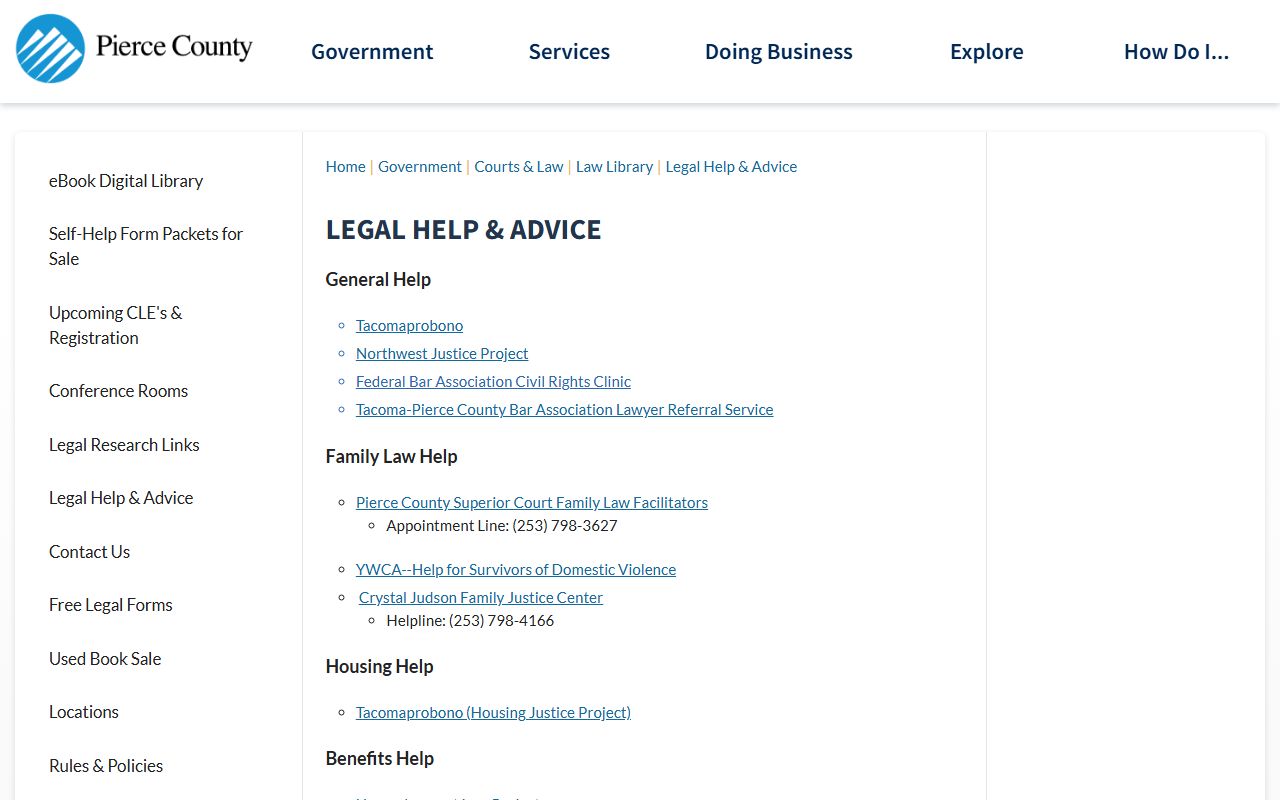
The page links to the Tacoma-Pierce County Bar Association Lawyer Referral Service at 253-383-3432 and to Legal Aid, reachable at 253-572-4343. Both are named resources for civil matters by the Department of Assigned Counsel when it cannot take a case.
The Pierce County Library maintains a law library with free access to legal materials. The library partners with TacomaProBono to offer Legal Help Pop-Up events where volunteers answer basic family law questions and eviction prevention issues. Check the Pierce County Library law library page for upcoming event dates.
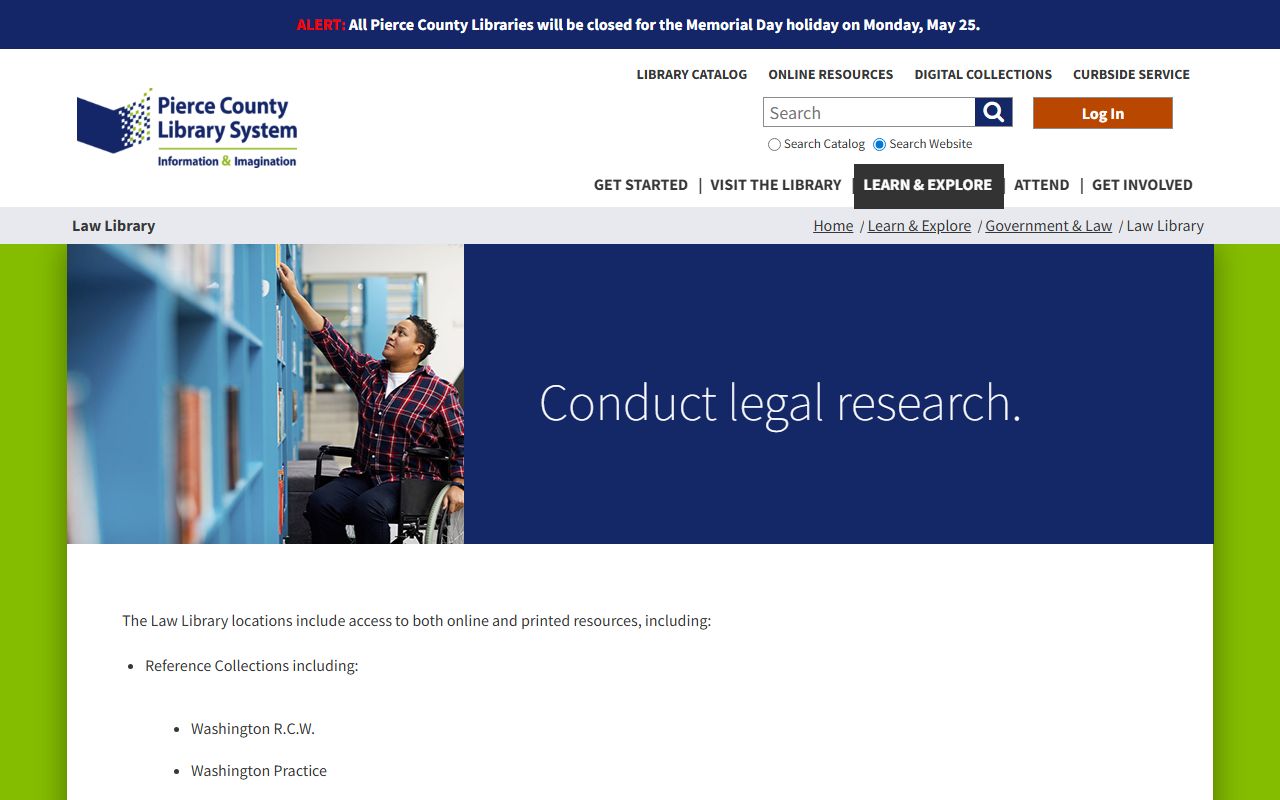
The library's law library section also links out to TacomaProBono's own resources, which can include pro bono attorney matching for qualifying matters.
For people who are unsure whether they qualify for a public defender, the county published a plain-language guide. It covers which case types qualify, what the income and asset screens look like, and what happens after the court refers a person to the Clerk's Pretrial Services. See the county's How to Obtain a Public Defender page for the full guidance.
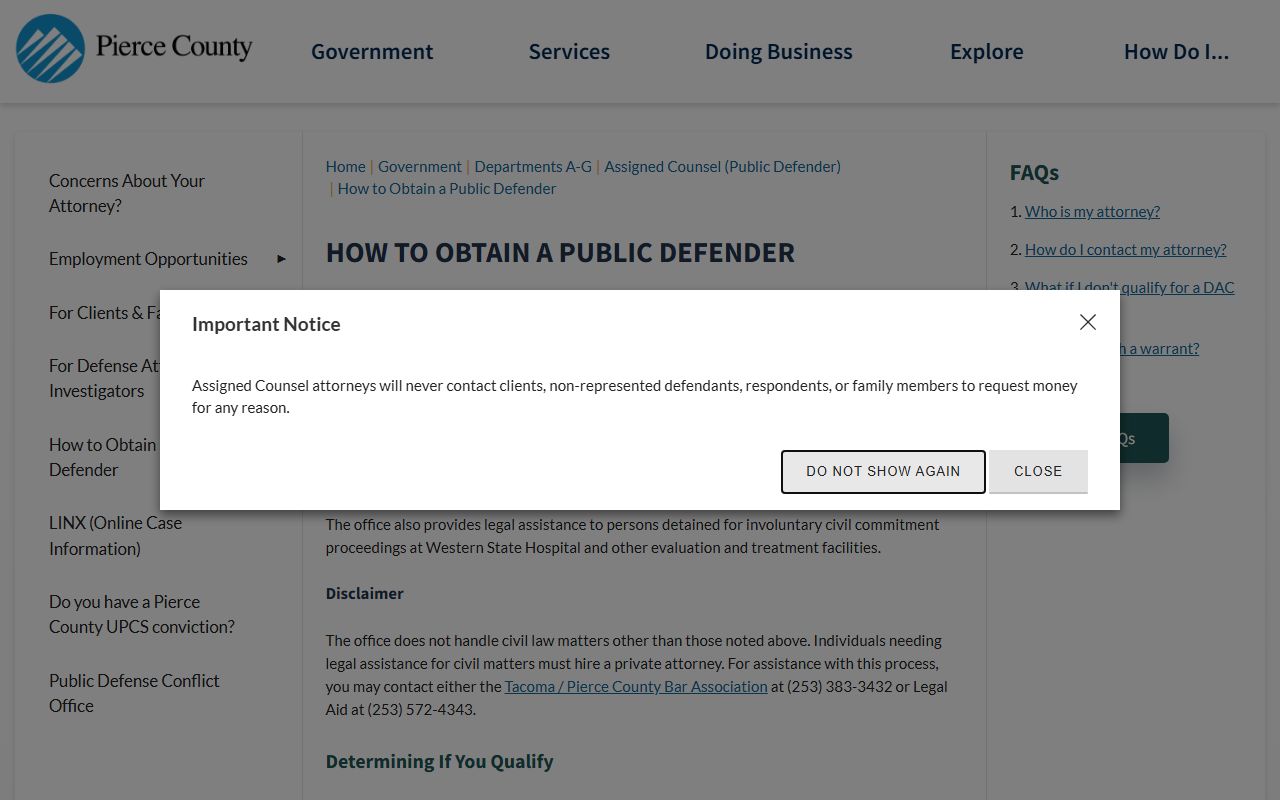
The guide notes that DAC does not handle civil matters except in mandated categories. For civil help, use the bar referral or Legal Aid contacts above.
The Department of Assigned Counsel itself describes its role and scope on its official page. DAC provides mandated indigent defense for eligible adults and juveniles in criminal, delinquency, dependency, termination, and involuntary commitment cases. Its application process runs through the Clerk's Pretrial Services function. Learn more at the Department of Assigned Counsel page.
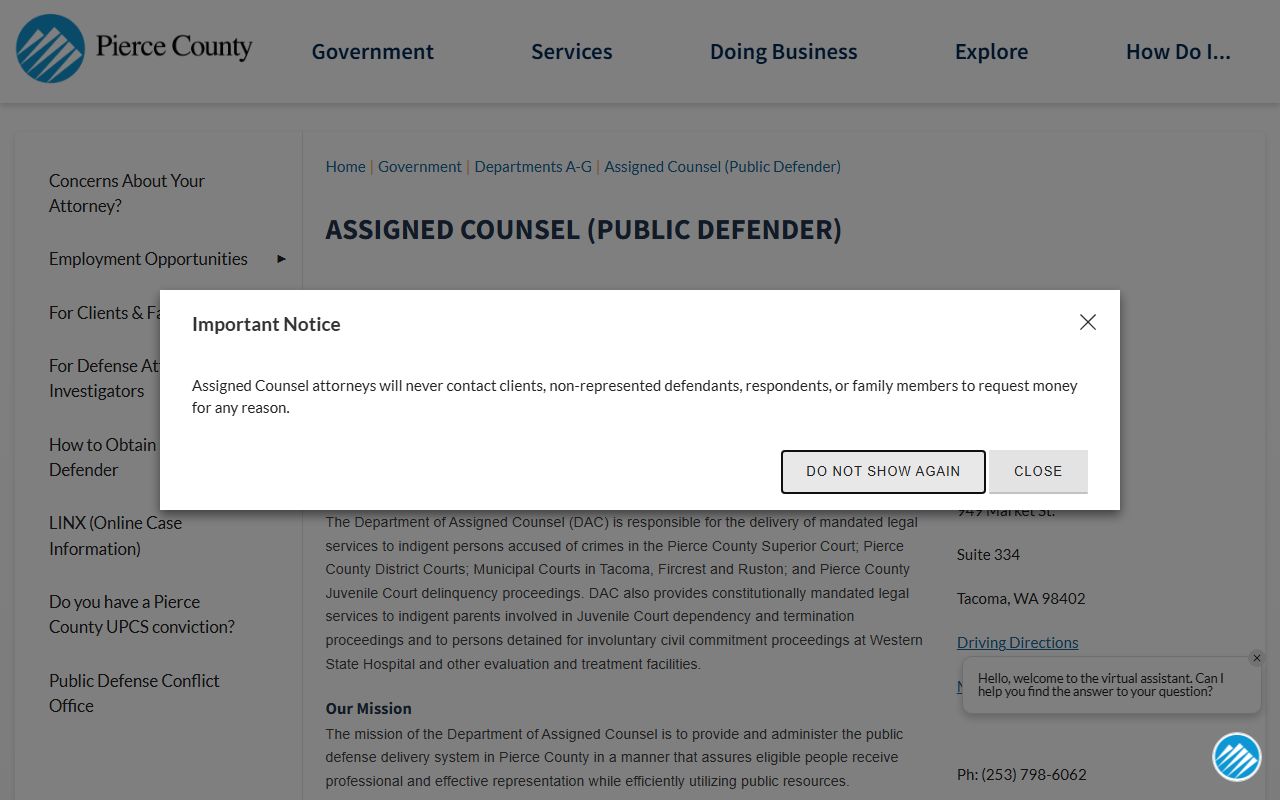
Cases that go beyond DAC's scope, including most civil and family-law disputes, are typically handled by private attorneys, legal aid, or the bar referral service.
The Pierce County Prosecuting Attorney handles criminal prosecution for the county and also runs a Victim/Witness Assistance program for crime victims, reachable at 253-798-6875. The Prosecuting Attorney's office is in Room 946 of the same County-City Building. Read more about the office and its divisions at the Pierce County Prosecuting Attorney page.
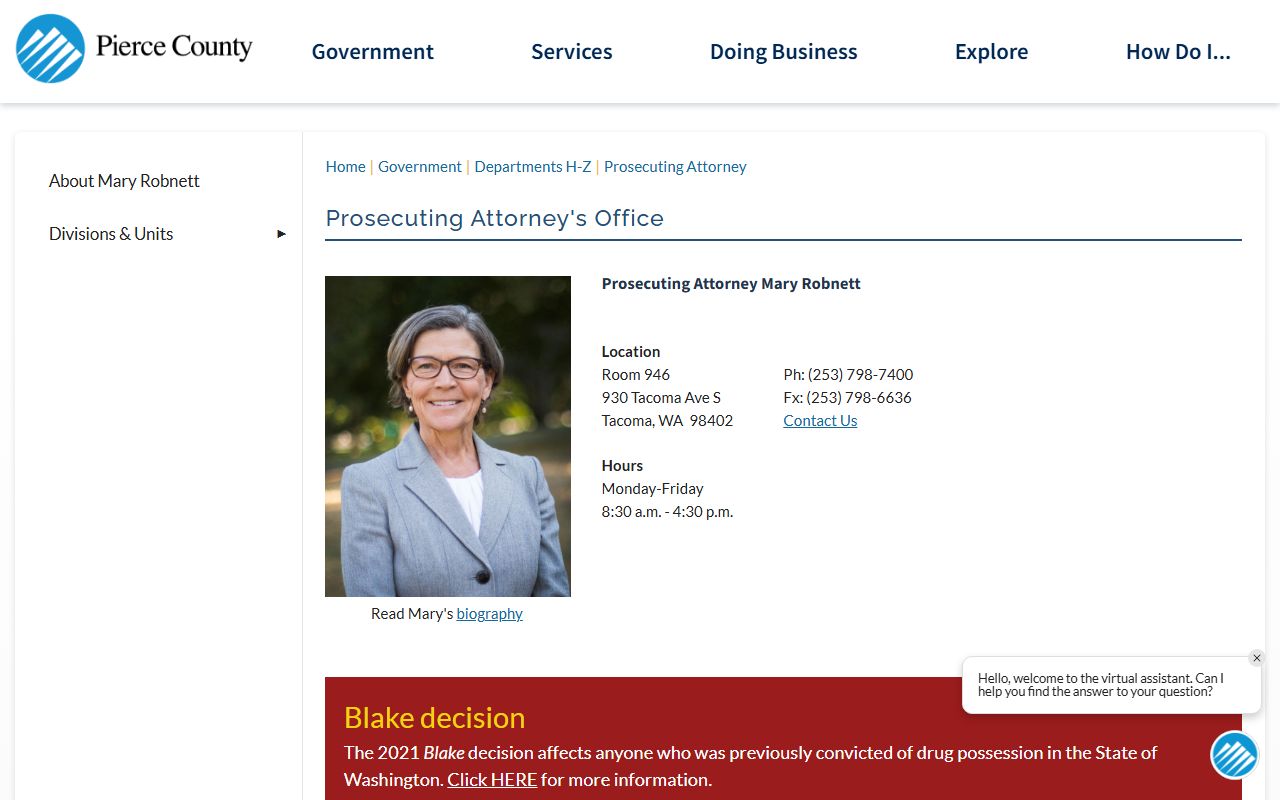
Victims involved in active cases may work with the Prosecuting Attorney's Victim/Witness unit alongside any court-record request they make through the Clerk's office.
Public Access Rules for Clerk Records
Washington treats court records and government agency records differently. Pierce County's own court records page states that court case records are not subject to the Public Records Act, Chapter 42.56 RCW, and points instead to Washington General Rule 31 for case-record access. That rule defines access as the right to view or obtain a copy and allows courts to limit access under federal law, state law, other court rules, court orders, or case law.
Some Superior Court records are restricted. Adoption files are confidential under RCW 26.33.340. Family law and guardianship records may have sealed financial source documents and personal identifiers under General Rule 22. A case index entry may appear in LINX while specific documents remain sealed. Mental health and civil commitment records are restricted under RCW 71.05.620. Court administrative records follow a different path under General Rule 31.1 rather than the case-record framework.
If you need access to a sealed document, the standard process is to file a motion to unseal under General Rule 15. The court may unseal the file, unseal specific documents, order redactions, or deny the request. The Clerk's office can tell you what is on file; it generally cannot override a sealing order without a court ruling.